

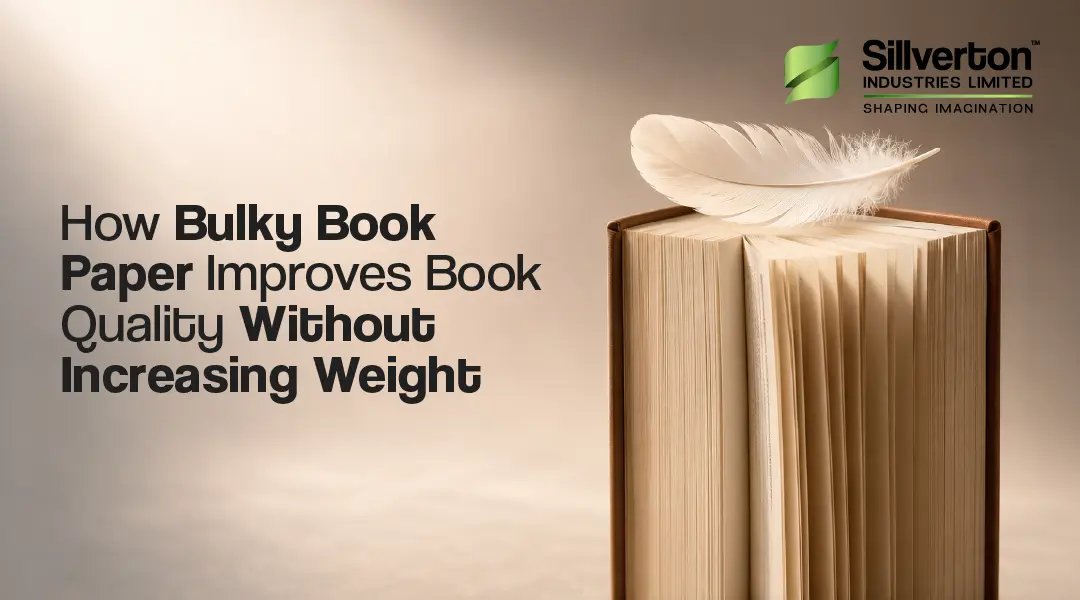
In book publishing, paper selection directly affects production cost, reader experience, print performance, and product positioning. Publishers today are balancing multiple requirements simultaneously: premium feel, manageable shipping weight, readability, and efficient printing performance.
This is where Bulky Book Paper has become increasingly relevant for commercial publishers, educational printers, religious publications, and high-page-count book manufacturing.
By offering greater thickness without proportionally increasing grammage, bulky paper helps create books that feel substantial while remaining lightweight and cost-efficient to handle across printing and distribution operations.
What Is Bulky Book Paper?
Bulky Book Paper is engineered to deliver higher caliper and volume compared to conventional paper grades at the same GSM.
In practical terms, this means:
- The paper feels thicker
- The book spine appears fuller
- The final product feels more premium
- Overall book weight remains controlled
This characteristic is especially important for publishers producing:
- Novels
- Educational textbooks
- Reference books
- Religious books
- Catalogues
- Long-format printed content
For high-page-count books, balancing thickness and weight becomes a critical commercial decision.
Why Book Bulk Matters in Publishing
Book buyers often associate thickness with value. A fuller spine and better page feel can improve shelf presence and perceived quality.
However, increasing GSM to achieve thickness also increases:
- Shipping costs
- Warehousing weight
- Postal expenses
- Handling costs
- Production material consumption
Bulky paper for book printing solves this challenge by improving page volume without excessively increasing paper mass.
This becomes commercially valuable for:
- Export-oriented publishing
- Educational distribution networks
- E-commerce book delivery
- Mass-volume print runs
- Lightweight paperback manufacturing
How Bulky Book Paper Improves Book Quality
Better Page Feel and Reader Experience:
Higher bulk creates a softer and more comfortable page-turning experience. Readers often perceive bulky paper books as easier to handle during extended reading sessions.
For publishers, tactile quality influences:
- Brand perception
- Reader satisfaction
- Product positioning in retail environments
Fuller Spine Appearance:
Books printed on high bulk printing paper achieve better spine thickness even at lower GSM levels.
This improves:
- Shelf visibility
- Spine readability
- Premium appearance for paperbacks and academic titles
For bookstores and distributors, spine presentation remains an important retail consideration.
Reduced Show-Through:
Many bulky grades provide improved opacity, helping reduce text visibility from the reverse side of the page.
This supports:
- Better readability
- Cleaner print appearance
- Improved reading comfort in dense-text publications
The benefit is especially important for educational and religious books where long reading durations are common.
Controlled Book Weight:
One of the biggest operational advantages is reduced overall book weight.
Lighter books contribute to:
- Lower freight costs
- Easier logistics handling
- Reduced postal expenses
- Improved portability for students and readers
For publishers managing large distribution volumes, weight optimization has direct commercial impact.
Applications of High Bulk Printing Paper
High bulk printing paper is commonly used in:
- Educational textbooks
- Paperback novels
- Dictionaries and reference books
- Religious publications
- Children's books
- Technical manuals
- Export publishing projects
Different applications may require varying combinations of:
- Opacity
- Smoothness
- Brightness
- Printability
- Bulk ratio
- Binding compatibility
Selecting the appropriate paper specification depends on both printing requirements and final product expectations.
What Publishers Should Evaluate Before Selecting a Supplier
Choosing a reliable bulky book paper manufacturer involves more than comparing GSM or pricing.
Publishers and printers should assess:
- Bulk consistency across batches
- Reel and sheet dimensional stability
- Print machine runnability
- Folding and binding performance
- Opacity levels
- Surface characteristics for ink absorption
- Supply consistency for repeat editions
For long-run publishing operations, substrate inconsistency can affect:
- Printing efficiency
- Binding quality
- Colour reproduction
- Inventory standardization
A dependable high bulk book paper manufacturer should understand both print production realities and publishing economics.
Sustainability and Material Efficiency Considerations
Publishers are also increasingly evaluating paper choices through sustainability and operational efficiency perspectives.
Higher bulk grades can support:
- Material optimization strategies
- Lower transportation loads
- Efficient packaging and logistics handling
- Improved production planning
However, performance consistency remains essential. Lightweight papers that compromise printability or durability may create additional operational inefficiencies during printing and distribution.
Conclusion
As publishers continue balancing production economics with reader expectations, Bulky Book Paper offers a practical solution for achieving premium book feel without excessive weight increase.
The right paper selection supports:
- Better reader experience
- Improved shelf presentation
- Efficient logistics
- Cost-conscious publishing operations
- Consistent print performance
Sillverton Industries Limited supports paper and packaging requirements through a manufacturing-focused approach aligned with printing performance, operational consistency, and evolving publishing industry expectations.
For technical discussions around bulky paper for book printing and specialized paper applications, businesses can connect with the team through the company website.
Recent Blog Posts
From Books to Drawing Books: Applications of Silver Bright Paper
Paper selection for books, notebooks, and drawing books is often treated as a GSM or cost decision. In practice, publishers, converters, and stationery...
Read More
Which Paper Is Used for Different Types of Packaging? A Complete Industry Guide
Selecting the right paper is one of the most important decisions in packaging design. While appearance matters, the primary role of packaging is to protect...
Read More
What Is Oil and Grease Proof Paper? Everything You Need to Know
Packaging for food products must do more than contain the product, it must preserve quality, prevent leakage, maintain hygiene, and support a positive...
Read More