

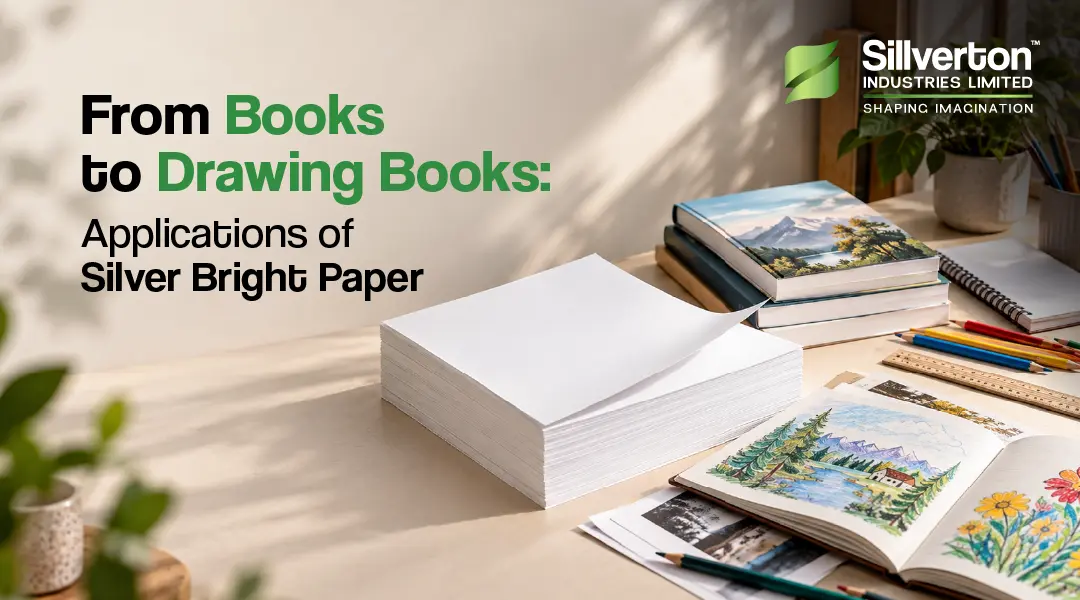
Paper selection for books, notebooks, and drawing books is often treated as a GSM or cost decision. In practice, publishers, converters, and stationery manufacturers need to consider several interconnected factors: surface feel, opacity, writing or drawing response, print performance, page strength, and consistency during binding.
Silver Bright Paper can address these requirements across selected publishing and stationery applications. Its clean appearance and functional surface characteristics make it relevant not only as Paper for Books, but also for drawing books and other converted paper products where the interaction between the page and the user matters.
Understanding the application requirements helps buyers specify the right paper rather than selecting a grade purely on appearance.
What Is Silver Bright Paper?
Silver Bright Paper is a paper grade developed to provide a clean, bright appearance along with surface and strength characteristics suitable for printing, writing, and converting applications.
For commercial buyers, however, brightness alone should not determine selection. The paper needs to perform consistently through printing, cutting, folding, binding, packing, and final use.
Depending on the application, important evaluation parameters can include:
- GSM and thickness consistency
- Surface smoothness
- Brightness and visual uniformity
- Opacity
- Print response
- Writing and drawing performance
- Strength during converting and binding
A balanced specification helps reduce production variability while delivering the page characteristics expected in the finished product.
Silver Bright Paper Applications in Book Production
One of the important Silver Bright Paper Applications is book manufacturing. Different books create different demands on paper, so the grade should be selected around the intended reading and production experience.
When evaluating Paper for Books, publishers and printers should consider opacity, readability, print reproduction, page turning, binding method, and finished book weight.
Good opacity, for example, helps limit show-through from printing on the reverse side. Consistent thickness contributes to predictable book bulk, while an appropriate surface supports uniform reproduction of text and graphics.
These considerations can make Silver Bright Paper relevant for selected educational books, general publications, workbooks, and similar printed formats, subject to the exact printing and binding specification.
Why Paper Selection Matters for Drawing Books
A drawing book places different demands on paper than a text-heavy publication.
Paper for Drawing Books must provide a surface that supports the intended drawing medium while remaining sufficiently robust during repeated handling. Excessively smooth or unsuitable surfaces may affect how pencils and other media interact with the sheet, while inadequate strength can result in premature tearing.
Manufacturers should therefore assess:
- Pencil response and line definition
- Erasing behaviour
- Surface consistency across sheets
- Resistance to routine handling
- Opacity between pages
- Binding compatibility
- Suitability for the intended drawing media
These characteristics directly affect product usability and should be tested against the specific stationery application rather than assumed from GSM alone.
Other Silver Bright Paper Uses
Beyond conventional books and drawing books, potential Silver Bright Paper Uses can extend to other paper products where clean presentation, printability, and converting performance are required.
- Notebooks and Exercise Books: Consistent surface and thickness can support routine writing, printing, ruling, cutting, and binding operations. For high-volume notebook production, paper uniformity can also contribute to more predictable converting performance.
- Educational and Activity Materials: Workbooks, practice books, colouring formats, and selected educational materials combine printed content with writing or drawing areas. The paper specification therefore needs to accommodate both production requirements and user interaction.
- Stationery and Converted Paper Products: Selected stationery formats can benefit from a bright, consistent sheet where appearance and functionality carry equal importance. Buyers should still validate the paper against the required printing process, finishing method, and end use.
Where Does Silver Glaze Interleaving Paper Fit?
Silver glaze interleaving paper serves a different functional purpose and should not be confused with paper selected primarily for books or drawing surfaces.
Interleaving paper is generally evaluated as a separating or protective layer between products, sheets, or surfaces. Depending on the application, buyers may prioritise smoothness, cleanliness, controlled thickness, and handling performance.
This distinction matters during procurement. Two papers may appear similar visually but be engineered around very different converting and end-use requirements.
How Should B2B Buyers Evaluate Silver Bright Paper?
Before approving a paper grade for commercial production, procurement teams, printers, publishers, and converters should evaluate more than the quoted price per tonne.
Key questions include:
- Does the GSM remain consistent across production lots?
- Is opacity appropriate for double-sided printing?
- Does the surface suit the intended printing, writing, or drawing process?
- How does the paper behave during cutting and binding?
- Does the finished product require a particular brightness or page feel?
- Can the manufacturer maintain specifications at the required order volumes?
Trial runs can provide valuable evidence before moving to large-volume procurement, particularly when launching a new product or changing an existing paper specification.
Match the Paper to the User and Production Process
The value of Silver Bright Paper lies in selecting it for the right application rather than treating brightness as the only criterion. From Paper for Books to Paper for Drawing Books, the required balance of opacity, surface performance, strength, appearance, and convertibility changes with the finished product.
Sillverton Industries Limited works with paper buyers and converters to address application-specific paper requirements. Businesses evaluating Silver Bright Paper for publishing, stationery, or converted paper products can explore Sillverton's paper portfolio or discuss their technical and production requirements with its team.
Recent Blog Posts
From Books to Drawing Books: Applications of Silver Bright Paper
Paper selection for books, notebooks, and drawing books is often treated as a GSM or cost decision. In practice, publishers, converters, and stationery...
Read More
Which Paper Is Used for Different Types of Packaging? A Complete Industry Guide
Selecting the right paper is one of the most important decisions in packaging design. While appearance matters, the primary role of packaging is to protect...
Read More
What Is Oil and Grease Proof Paper? Everything You Need to Know
Packaging for food products must do more than contain the product, it must preserve quality, prevent leakage, maintain hygiene, and support a positive...
Read More