

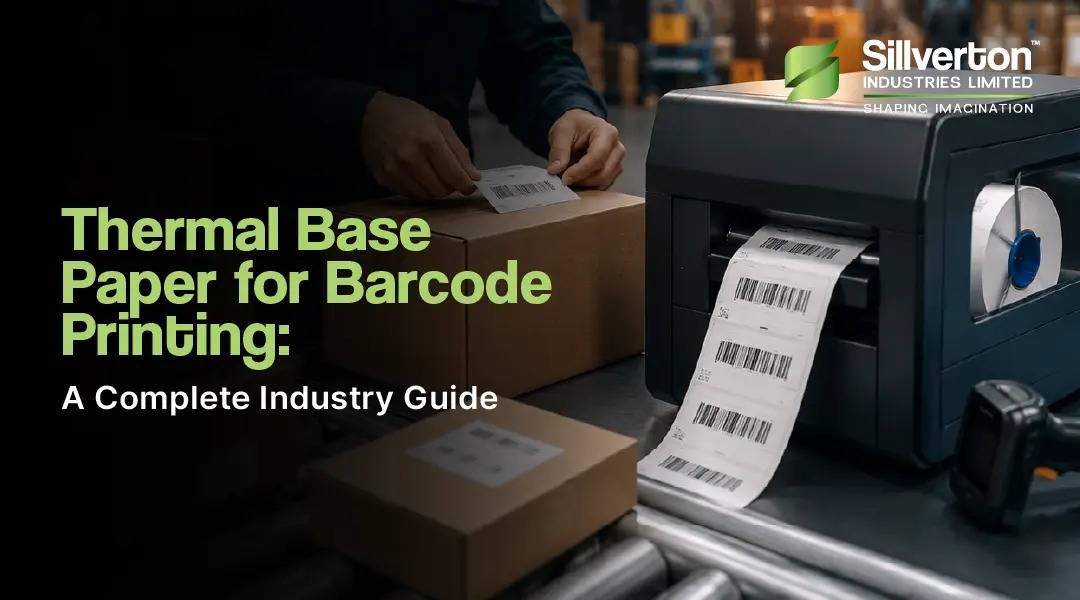
Barcode printing plays a critical role across modern supply chains. From retail billing counters and warehouse logistics to pharmaceutical labelling and food delivery packaging, barcode readability directly affects operational speed, inventory accuracy, and traceability.
At the center of this process is thermal base paper, the foundation material used to produce thermal paper rolls for barcode printers, POS systems, labels, and tracking applications. For businesses evaluating packaging and printing materials, understanding how thermal base paper performs under different operational conditions is essential.
This guide explains what thermal base paper is, why it matters in barcode printing applications, and what businesses should evaluate before selecting a supplier or converting partner.
What Is Thermal Base Paper?
Thermal base paper is a specially engineered paper substrate designed to receive thermal coatings used in direct thermal printing applications.
Once coated, the material becomes Thermal Paper capable of producing printed output through heat activation instead of ink or toner. This technology is widely used because it supports:
- Fast printing speeds
- Low-maintenance printing systems
- Compact printer configurations
- High-volume transactional printing
In barcode printing, print clarity and image stability are especially important because scanning failures can interrupt warehouse operations, retail transactions, or product tracking systems.
The quality of the thermal base paper directly influences:
- Barcode sharpness
- Print durability
- Heat sensitivity consistency
- Roll runnability during high-speed printing
- Storage performance under varying environments
Why Thermal Base Paper Matters in Barcode Printing
Barcode printing environments demand consistency. Even small variations in paper smoothness, coating absorption, or moisture balance can affect scanner readability.
For sectors such as FMCG, logistics, QSR, and pharma, barcode failures create operational inefficiencies including:
- Delayed dispatch processing
- Inventory mismatches
- Re-labelling costs
- Checkout delays
- Traceability issues in regulated products
For this reason, rather than concentrating solely on the final thermal roll, companies are increasingly assessing the base paper quality.
A high-performance thermal base paper helps maintain:
- Uniform thermal coating application
- Controlled image density
- Reliable machine conversion performance
- Stable print output during long production runs
Key Properties Businesses Should Evaluate
When sourcing thermal paper substrates, procurement and packaging teams should assess technical performance parameters rather than relying only on GSM or pricing.
- Surface Smoothness: Smoothness affects coating uniformity and print clarity. Uneven surfaces can create inconsistent barcode edges that reduce scanning accuracy.
- Dimensional Stability: Thermal Paper rolls used in logistics and retail environments may face changing humidity and storage conditions. Stable base paper reduces curling, wrinkling, and printer jamming.
- Moisture Control: Moisture balance influences both coating performance and roll durability. Poor moisture management can affect print consistency during storage and transport.
- Opacity and Brightness: For barcode labels and receipts, good opacity improves readability while controlled brightness supports clean image contrast.
- Strength Properties: Barcode applications often involve continuous roll movement through thermal printers. Adequate tensile and burst strength help minimize tearing during high-speed usage.
Industry Applications of Thermal Paper
The demand for thermal paper continues to expand as businesses adopt automated billing, tracking, and inventory systems.
Common applications include:
- Retail POS billing rolls
- Warehouse barcode labels
- Shipping and logistics labels
- Food delivery receipts
- Pharmacy transaction slips
- Product tracking systems
- Weighing scale labels
- Queue management systems
Each application may require different paper characteristics depending on print speed, storage duration, image retention requirements, and environmental exposure.
Considerations for Selecting a Manufacturer of Thermal Paper Bases
Selecting a reliable thermal paper base manufacturer involves more than production capacity alone. Businesses should evaluate whether the supplier can maintain consistency across large-volume orders and varying operational requirements.
Important evaluation factors include:
- Uniform paper formation
- Consistent reel quality
- Controlled moisture parameters
- Reliable bulk supply capability
- Compatibility with thermal coating processes
- Manufacturing quality controls
- Sustainability and sourcing practices
For converters and packaging companies, inconsistent substrate quality can increase coating rejection rates and production downtime.
A dependable thermal paper manufacturer India should also understand the performance expectations of domestic retail, logistics, and export-oriented industries.
The Growing Focus on Sustainable Thermal Paper Production
Sustainability considerations are increasingly influencing procurement decisions in packaging and paper sourcing.
Businesses today evaluate:
- Responsible fibre sourcing
- Manufacturing efficiency
- Reduced material wastage
- Recyclability considerations
- Optimized paper performance for reduced operational losses
For barcode printing applications, material efficiency matters because poor-quality rolls often generate excess waste through printer jams, reprints, and rejected labels.
Manufacturers aligned with performance consistency and responsible production practices are becoming preferred long-term partners for industrial buyers.
Conclusion
As barcode printing becomes more integrated into retail, logistics, pharma, and FMCG operations, the importance of high-quality thermal base paper continues to grow.
The right substrate supports printing consistency, operational reliability, and smoother packaging workflows across high-volume environments. Businesses evaluating Thermal Paper solutions should look beyond pricing and focus on substrate quality, conversion compatibility, and supply consistency.
Sillverton Industries Limited supports industrial packaging and specialty paper requirements with a manufacturing-focused approach aligned with performance, operational reliability, and evolving packaging industry expectations.
To explore paper solutions for barcode printing and packaging applications, connect with the team through the company website for technical discussions and product consultation.
Recent Blog Posts

From Books to Drawing Books: Applications of Silver Bright Paper
Paper selection for books, notebooks, and drawing books is often treated as a GSM or cost decision. In practice, publishers, converters, and stationery...
Read More
Which Paper Is Used for Different Types of Packaging? A Complete Industry Guide
Selecting the right paper is one of the most important decisions in packaging design. While appearance matters, the primary role of packaging is to protect...
Read More
What Is Oil and Grease Proof Paper? Everything You Need to Know
Packaging for food products must do more than contain the product, it must preserve quality, prevent leakage, maintain hygiene, and support a positive...
Read More