
A product may leave the production line in perfect condition, but its packaging still has to perform through warehousing, pallet movement, loading, transportation and distribution. At each stage, compression, vibration, repeated handling and changing storage conditions can put the packed product at risk.
This is where secondary packaging solutions become an important logistics consideration. Beyond grouping individually packed products, effective secondary packaging helps businesses improve load protection, handling efficiency and space utilisation throughout the supply chain.
For procurement and packaging teams, the objective is therefore not simply to select a box or wrapping material. It is to specify a packaging system that matches the product, distribution route and actual handling conditions.
What Role Does Secondary Packaging Play?
Secondary packaging sits outside the primary pack and typically combines multiple product units into a manageable distribution format.
Depending on the application, secondary packaging systems may include corrugated boxes, cartons, paper-based wraps, dividers and other protective components.
Their performance affects several operational areas:
- Protection against compression and handling damage
- Easier product consolidation and movement
- More organised warehouse stacking
- Better palletisation and load stability
- Reduced risk of damage during distribution
For FMCG, food and beverage, pharma and retail businesses moving large product volumes, these factors can directly influence logistics efficiency and product loss.
Improving Storage Through Better Packaging Design
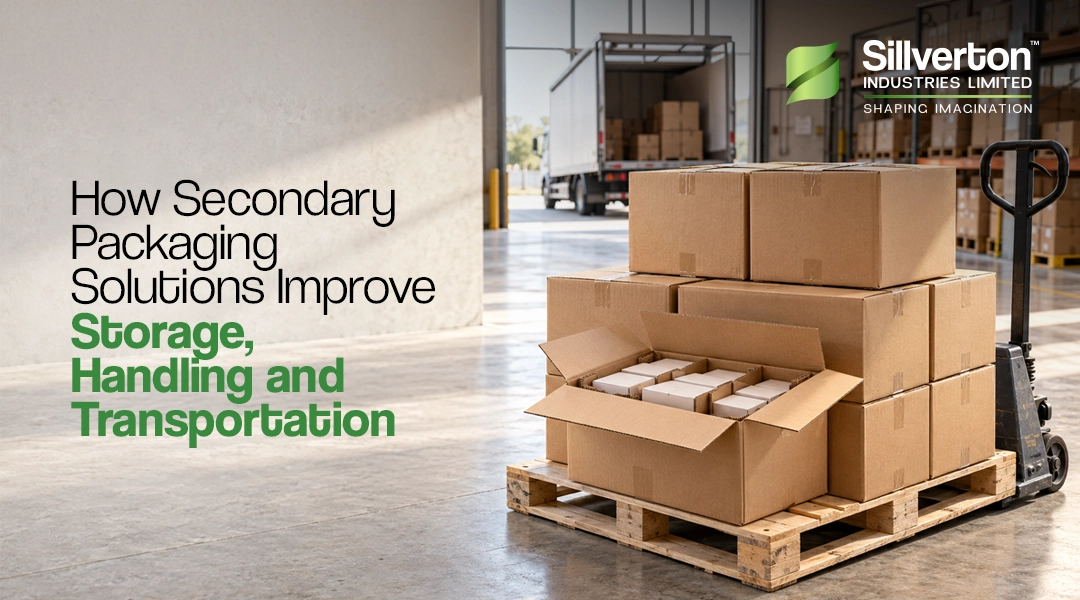
Warehouses place secondary packs under sustained physical stress. Cartons may be stacked for extended periods, moved between storage locations or exposed to variations in humidity and temperature.
Effective secondary packaging for storage and handling should therefore be selected according to the expected stacking load, storage duration and product weight.
Paper selection becomes particularly important when corrugated boxes must withstand stacking, repeated movement and different load conditions. Sillverton’s secondary packaging range includes Virgin Top Liner (Brown), available in 180–350 GSM, and Virgin Kraft Liner (VKL), available in 300–400 GSM. These options allow converters and packaging teams to evaluate liner paper according to the strength and construction requirements of the finished corrugated pack, rather than relying on a single paper specification for every application.
Appropriate specifications can help warehouses maintain stable stacks while avoiding unnecessary material use caused by over-engineered packaging.
Making Manual and Automated Handling More Efficient
Packaging passes through several touchpoints before reaching its destination. Conveyor systems, forklifts, pallets, loading equipment and manual handling can all introduce different mechanical stresses.
A secondary pack that loses shape, tears easily or cannot maintain structural integrity can disrupt these operations.
When evaluating packaging solutions for logistics, businesses should consider:
- Pack dimensions and compatibility with pallets
- Compression and stacking requirements
- Resistance to tearing during handling
- Product weight and number of primary packs per case
- Compatibility with packing and material-handling equipment
The aim is to develop a pack that moves predictably through the logistics system, rather than treating packaging and warehouse operations as separate decisions.
Protecting Products During Transportation
Transportation introduces vibration, movement, compression and repeated loading and unloading. Long-distance distribution or multi-stage supply chains can increase these stresses further.
This makes secondary packaging solutions for transportation particularly important for products moving between manufacturing plants, distribution centres, retailers and fulfilment facilities.
For corrugated boxes, performance depends on how the complete board construction responds to stacking pressure, movement and repeated handling. The selected liner paper forms part of that construction and should be specified according to the weight of the packed goods and the conditions the box is expected to face in distribution. Options such as Virgin Top Liner (Brown) and Virgin Kraft Liner (VKL) give packaging teams additional specifications to consider when designing secondary packs for different transportation and load requirements.
However, higher GSM alone should not be treated as the answer. Material selection should consider the complete packaging design, product load, corrugation structure and expected distribution environment.
Where Does Sustainable Secondary Packaging Fit?
Sustainable secondary packaging should balance material efficiency with adequate protection. Reducing material without validating performance can lead to damaged products, repacking and additional logistics movements, which may undermine the intended sustainability benefit.
Businesses should instead examine whether paper-based packaging can deliver the required strength with an efficiently specified material structure.
This makes performance optimisation important: use enough material to protect the load reliably, but avoid unnecessary over-specification.
Choosing Secondary Packaging Solutions in India
When evaluating secondary packaging solutions in India, procurement teams should look beyond price per tonne or packaging unit. The paper specification needs to suit the converting process and final logistics application.
Key evaluation points include strength requirements, GSM, consistency, print requirements, converting performance and the expected storage and transportation environment.
Sillverton Industries manufactures paper-based packaging solutions and includes secondary packaging among its core application categories, with papers intended for corrugated boxes and industrial wrapping. This application-focused approach allows packaging teams to evaluate paper according to the performance required from the finished pack rather than selecting material on cost or GSM alone.
Build Secondary Packaging Around the Supply Chain
Effective secondary packaging connects product protection with storage, handling and transportation requirements. The right specification can support stable stacking, efficient movement and reliable transit protection without unnecessary material consumption.
For businesses reviewing corrugated packaging, liners or paper-based secondary packaging, the starting point should be the actual logistics environment.
Explore Sillverton Industries ’ secondary packaging solutions and discuss your application requirements with its team to identify paper specifications aligned with your converting, storage and transportation needs.